The Best (Online) Public Speaking Courses in 2026 – From Someone Who Spent €50,000 On Them

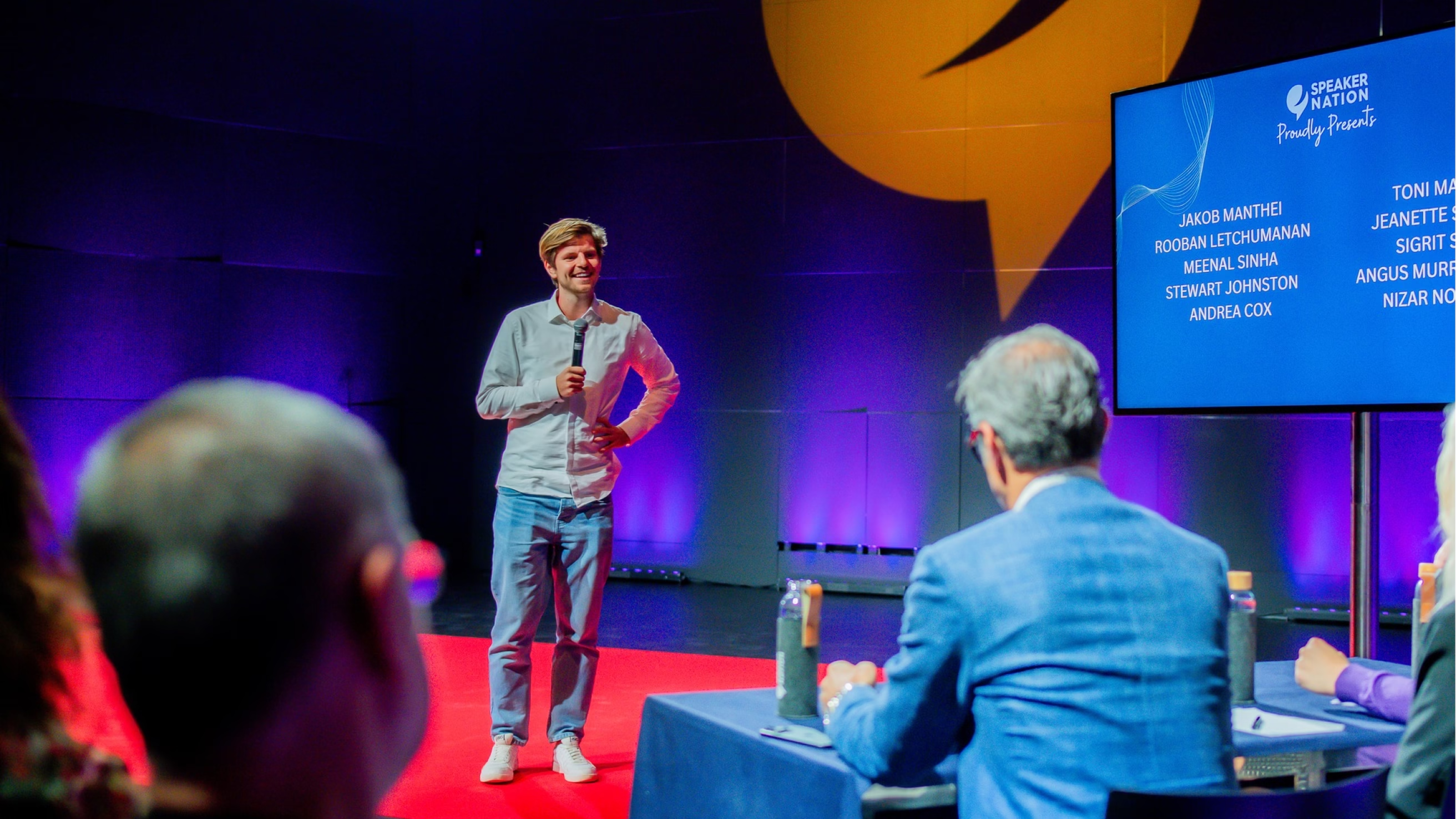
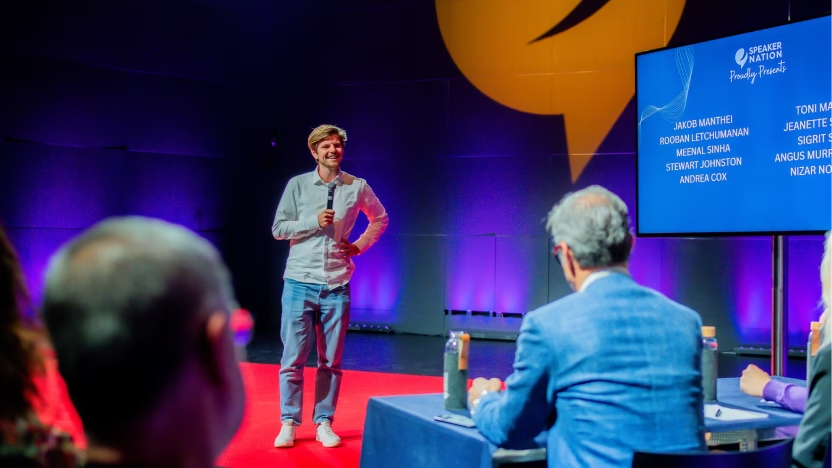
I've spent roughly €50,000 on public speaking training.
Not on a single program. On all of them: Dale Carnegie's two-day workshop, Vinh Giang's academy, Eric Edmeades' Speaker Academy, the David JP Phillips course, Mindvalley's Speaking & Influence Mastery, the BBC Maestro course with Richard Greene, Ultraspeaking, a one-on-one coach at €250 an hour, Toastmasters, AI feedback apps, university programs, and a few others I'm probably forgetting.
I went through all of them as a student. I paid full price for most of them. And between any of this, I spent another fifteen thousand euros becoming a certified Dale Carnegie trainer myself, which means I've also seen the inside of how speaking programs are designed and sold.
Full disclosure before we go any further: I'm a co-founder of Complete Presenter, one of the programs I'll discuss in this article. So you have every right to be skeptical. I've tried to write the piece I wish existed when I started — one that names competitors honestly, tells you when our program isn't the right fit, and gives you a framework to choose with rather than a sales pitch dressed up as a review.
Here's what €50,000 of speaking education actually taught me:
There is no single best public speaking course. Every program I joined had something genuinely valuable, and every program had something missing. Most failed for the same reason — they taught information or they gave practice, almost never both. The ones that tried both usually got each piece half-right.
The article below is the breakdown I wish I'd had: who each program is good for, who should skip it, and what to combine to actually get good. There's a comparison table you can scan in thirty seconds, honest reviews of each program, and a framework for choosing based on where you actually are right now.
If you only have thirty seconds, here's the headline: the right course for you is the one that teaches what you don't know, in the format you'll actually finish, with someone watching while you practice. Everything else is decoration.
1. How I Evaluated Each Program
Most "best of" articles for public speaking courses have no evaluation criteria. They list ten programs, hand each a generic blurb, and expect you to figure out which one fits your situation. Going through €50,000 of training taught me the criteria most articles use — instructor pedigree, curriculum length, certificate availability — are usually the wrong ones.
Here are the five I actually used. The first two are the ones almost no review writes about. They're also the two that predict whether you'll actually improve.
1. Practice volume and feedback. The single most accurate predictor of whether a program changes how you speak is how often you will actually speak during it — and whether anyone watches you and tells you what's working. You can binge ten hours of speaking lessons and gain nothing measurable. Watching someone else speak well does not make you speak well. You only get better when someone watches you, points at the specific thing you're doing wrong, and makes you do it again.
2. Instructor caliber. A surprising number of speaking courses are taught by people who, when you actually watch them speak, are mediocre. Slick landing pages, average delivery. Before judging a course, I watched the instructor's own talks. If they couldn't do what they were teaching, I downgraded the program regardless of branding.
3. Curriculum depth. Some programs cover only the obvious: don't say "um," make eye contact, smile. That's not a course, it's a Twitter thread. Real curriculum goes deeper — vocal variety, narrative structure, audience adaptation, recovering from mistakes, handling questions you don't have answers for.
4. Format and time commitment. Self-paced versus live. Total hours required. Flexibility around real-life schedules. A self-paced video course is excellent if you'll actually finish it and useless if you won't.
5. Cost-to-value. Not absolute price, but price relative to what you actually receive. A free course with no feedback may cost more in wasted weeks than a paid course with live coaching.
The two criteria I keep returning to are practice with feedback and can the instructor actually do what they're teaching. Those are the ones I'd use even if I were starting over from scratch.
2. The Comparison Table
Here's how the major programs I went through stack up at a glance. Detailed reviews follow.
A few quick observations:
Most programs sit in one of two camps. Either they offer information without feedback (David JP Phillips, Vinh Giang, BBC Maestro, both Mindvalley programs) or they offer practice without much information (Ultraspeaking, Toastmasters, AI apps). The programs that try to combine both — Dale Carnegie, Complete Presenter, the Speaker Academy — sit at the higher end of the price spectrum, which isn't a coincidence.
Price does not predict quality. Some of the most expensive programs in this list were genuinely valuable; others were not worth a fraction of what I paid. Toastmasters at €100 a year outperforms several €3,000 courses on the dimension that matters most — actual stage time.
The cheapest option is also the slowest. Toastmasters costs almost nothing and gives you a real audience to practice in front of. The catch is that "real progress" measured in months becomes "world-class" measured in seven to ten years of consistent attendance.
3. Detailed Reviews
A note on the order before we start. I've sorted these roughly by how widely known each program is — the household names first, then specialized and emerging options. The one exception is Complete Presenter, which sits in position two even though it's the newest program on this list. That's a deliberate choice on my part: it's the program I co-founded, and I'd rather put it directly next to the most established programs in the space so you can judge it against them, than tuck it at the end as a brand mention. There's a disclosure on that review and a "where it falls short" section that's as honest as I can write it.
Dale Carnegie — 2-Day Public Speaking Workshop
- What it is. An in-person two-day intensive built around delivering multiple short presentations, each one filmed and reviewed. Dale Carnegie has been running variants of this course for nearly a century, which is part of why it's the most globally recognized name in this space.
- What I genuinely liked. The single most valuable element was the filming and feedback loop. Across two days, you deliver around seven presentations, each one recorded, and you sit with a trainer to watch yourself back. That experience — seeing yourself speak, on camera, with someone qualified pointing at the specific things you're doing — is one of the most accelerating things you can do as a speaker. I've recommended that single practice to almost every student I've worked with since.
- Where it fell short for me. Two days is two days. You can do meaningful work in that window, but you can't transform. I also felt the pacing skewed heavily toward preparation — we'd spend nearly an hour preparing for a two-minute presentation, then sit and listen to others present. The ratio of prep to actual speaking didn't match how speaking works in real life, where 99% of what you say is improvised on the spot.
- Who should pick it. People who can carve out two days and want a high-intensity introduction with serious filming and feedback. Just know that two days is a starting point, not a complete arc.
Complete Presenter
Disclosure: I'm a co-founder of this program. Read this section with that in mind, and use the other reviews here to triangulate. I've tried to write the "where it falls short" section as honestly as I'd write it about a competitor.
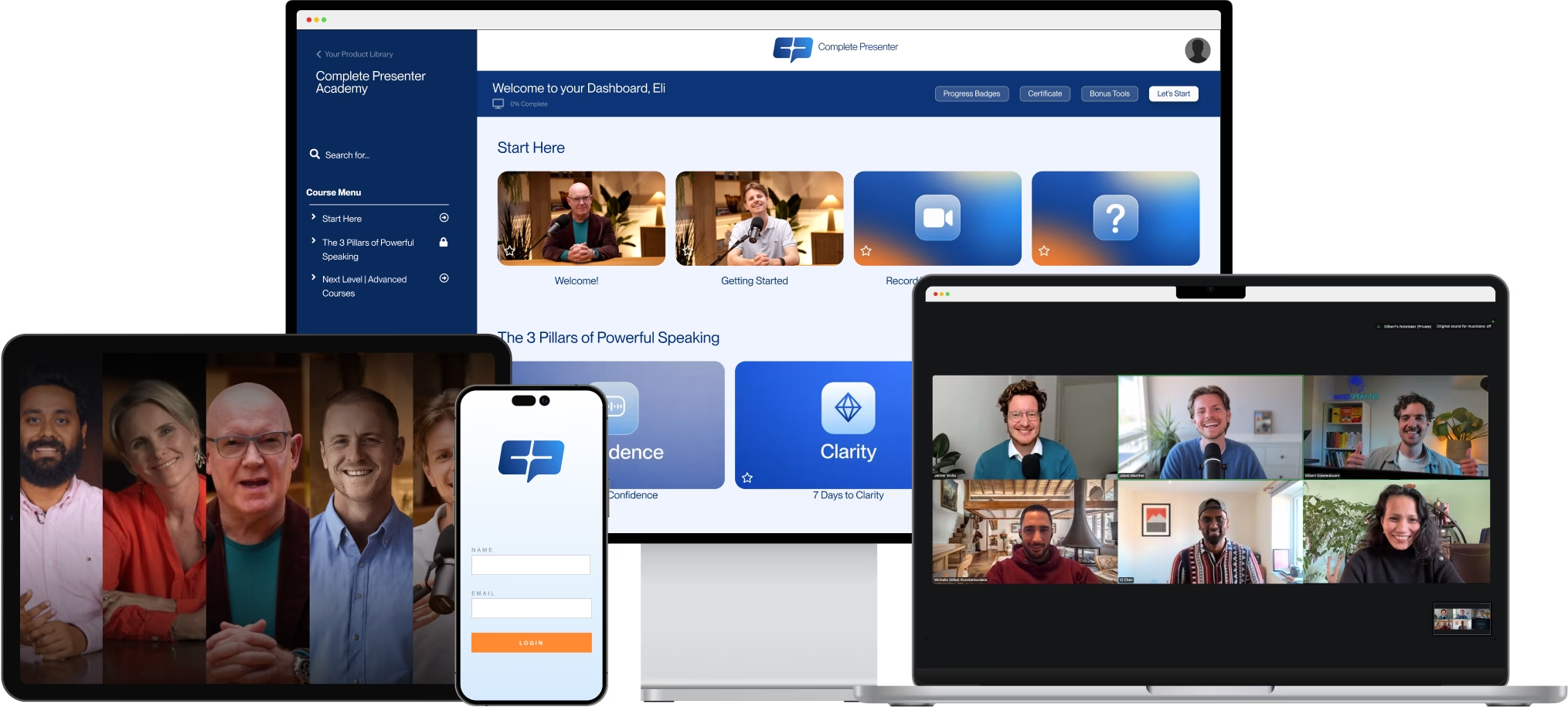
- What it is. A hybrid program built around a 21-day foundations course covering Confidence, Clarity, and Compelling delivery, followed by an on-demand library of focused courses taught by Toastmasters World Champions and TED speakers. Depending on tier, it includes bi-weekly live group practice sessions and 1:1 coaching with working speakers.
- What it does well. The structure is the program I wish I'd found when I started — and the structure is the argument of this whole article: confidence is taught first because nothing else lands without it; practice is scheduled into the program rather than left as a "you should also..."; feedback comes from human instructors, not software. The on-demand library compresses what would otherwise be hundreds of hours of premium content into focused lessons on the highest-leverage skills.
- Where it falls short. It's new. Launched recently, which means the community is smaller than Toastmasters' decades-old network and the brand recognition is nowhere near Dale Carnegie's. If a thirty-year public reputation matters to you, this isn't yet that. We're also explicitly not built for someone who only wants pre-recorded video and no live component — the practice sessions and 1:1 work are central to the model, and without them, BBC Maestro at €100/year is a better fit.
- Who should pick it. Working professionals who've absorbed enough content (free or paid) to know they need structure and feedback to actually change how they speak — and who can commit to roughly 15 minutes a day for 21 days plus regular live sessions. Most of our students have already tried one of the programs in this article, gotten partial value from it, and realized they needed more than one piece of the puzzle.
Vinh Giang Academy
- What it is. Online lessons from Vinh Giang, an Australian magician turned communication trainer with one of the largest social-media followings in the speaking space. If you've spent any time on Instagram or YouTube looking at speaking content, you've almost certainly seen him.
- What I genuinely liked. A few of his pieces on vocals and storytelling were useful starting points — particularly the basics of vocal variety. His own delivery is excellent, which matters; he can do what he's teaching.
- Where it fell short for me. It didn't go deep on anything. The lessons hit the surface of each topic but didn't unpack the underlying mechanics enough to actually change how I spoke. And like all pure-video courses, no practice element.
- Who should pick it. Useful as an introductory exposure to communication concepts if you're new to the space and want a recognizable name. If you've done structured work elsewhere, you'll find it covers familiar ground.
Mindvalley Speaking & Influence Mastery
- What it is. A premium online program in the Mindvalley ecosystem — a series of pre-recorded lessons plus occasional Zoom Q&A calls. Mindvalley is one of the best-known platforms in the personal development space, so this program gets a lot of visibility.
- What I genuinely liked. It was structured. The platform itself is well-produced. The lessons are reasonably comprehensive.
- Where it fell short for me. This was the program I felt most overpriced for what it delivered. Content was almost entirely video. Real practice was rare. The Q&A calls were Q&A — not practice with feedback. And the lessons came from a single instructor, which meant every concept was filtered through one person's view. The deeper issue I felt across all the Mindvalley courses I tried was dilution. Thirty-plus sessions of 90 minutes each, all valuable in some sense, but spread so thin that the actual gold — the 10% of insights that genuinely change how you speak — was buried in 30 hours of context. I kept thinking: what if someone took the highest-leverage 10% from each great teacher in this space and compressed it into something tight?
- Who should pick it. People already inside the Mindvalley ecosystem who want a comprehensive speaking module as part of a broader self-development practice. If you're buying speaking training specifically, there are programs at a fraction of the price that deliver more.
David JP Phillips — Online Course
- What it is. A comprehensive online program from one of Europe's most-watched speakers on storytelling and presentation. His TED talks on storytelling and Death by PowerPoint have collectively been viewed tens of millions of times.
- What I genuinely liked. The most content-rich speaking course I've encountered. Forty-plus hours of video lessons built on a scientific foundation — his "110 Steps" model is the result of seven years studying 5,000 speakers. The depth is unlike anything else in this article. Watching the lessons, I genuinely felt I was learning.
- Where it fell short for me. There was nowhere to practice. The format is video plus occasional Q&A calls. I came away with more concepts than I knew what to do with, none of which I'd been forced to actually apply in front of someone qualified to tell me whether I was applying them well. This, transparently, is the reason we wanted to bring his core teaching onto the Complete Presenter platform — the content is too good to leave in a format where it can't translate into actual skill.
- Who should pick it. People who already practice regularly (Toastmasters, work presentations, a coach) and want a comprehensive content layer to fill in the gaps. If you're going to learn his frameworks, do it alongside something that puts you in front of an audience weekly.
BBC Maestro — Richard Greene
- What it is. A 7-hour, 26-lesson course on the BBC Maestro platform, taught by Richard Greene — speech coach to Tony Robbins, Princess Diana's coaching team, and a long list of CEOs and political figures. His TED talk "The 7 Secrets of the Greatest Speakers in History" is the conceptual spine of the course.
- What I genuinely liked. Greene is a genuinely interesting thinker about charisma, and the BBC Maestro production values are excellent — well-shot, well-paced, easy to watch. The 7 Secrets framework is sound.
- Where it fell short for me. Honestly, I stopped halfway through. Without any practice or feedback component, I lost momentum. The €100/year subscription is genuinely fair for the quality of what's there — but expecting it to transform your speaking would be unfair to the course.
- Who should pick it. People who want a structured introduction to public speaking theory at an unusually low price. As a starting point for someone curious about the space, it's hard to beat the value.
Eric Edmeades Speaker Academy
- What it is. A five-day in-person intensive run by Eric Edmeades, a long-time keynote speaker. Roughly 80% Eric on stage teaching and demonstrating, 20% participants practicing.
- What I genuinely liked. This was the first time I spent five days in a room with a true keynote-level speaker. Watching him work for eight hours a day, for five straight days, was an education in itself. He's good enough that listening to him speak for that long was genuinely enjoyable — which is the lesson hiding in plain sight. Behind-the-scenes insights, stage stories, the texture of how a working speaker actually thinks about a room. I came out knowing how to be okay standing on a stage at the start of a presentation, which sounds small but isn't.
- He also said something to me during that week that genuinely changed my trajectory. I won't paraphrase it perfectly, but the gist was: you're a rockstar, do something with it. Inspire the world. It's the kind of thing you don't easily forget when it comes from a keynote speaker you've watched perform for five days.
- Where it fell short for me. With fifty people in the room, the practice component was limited. I learned an enormous amount from watching, but most of what I absorbed was content I had to figure out how to apply on my own afterwards. There was no structured follow-up.
- Who should pick it. People with serious budget who want to spend a week in a room with a master and accept that the integration work happens afterwards. If your goal is keynote speaking specifically, this is genuinely valuable. If your goal is becoming more compelling in work meetings and presentations, the math probably doesn't work out.
Mindvalley Spotlight Effect (Eric Edmeades)
- What it is. A shorter course on the Mindvalley platform taught by Eric Edmeades, focused on mindset and the psychology of being seen.
- What I genuinely liked. Where I first encountered Eric — who I'd later spend five days with at his Speaker Academy. The mindset content, particularly around overcoming the fear of being judged, is genuinely useful and not what most speaking courses teach.
- Where it fell short for me. Same structural issue as everything else in this category. Information without practice.
- Who should pick it. If you already have a Mindvalley membership, it's worth a watch for the mindset content alone. As a standalone reason to subscribe, probably not.
Ultraspeaking
- What it is. A live cohort program built around fast-paced speaking games and small-group practice. Sessions of three to five people, short rounds of speaking, peer and coach feedback in real time.
- What I genuinely liked. Foundations Level 1 — their 30-day starter program — was one of the most valuable speaking experiences I've ever paid for. The speaking games are well-designed. The small-group format means you actually speak a lot in every session. The coaches step in when you're stuck. It pulled me out of the performative speaking mode I'd absorbed elsewhere and got me speaking like myself again.
- Where it fell short for me. After Foundations Level 1, the returns dropped sharply. Level 2 and Professional Level 1 didn't teach me much new. The model is almost entirely practice — no structured curriculum to learn from between sessions, no frameworks to internalize. You leave each session feeling looser and more authentic, but not necessarily more compelling.
- Who should pick it. People whose biggest blocker is the performative-speaker mask — who know what they want to say but freeze the moment they're being watched. Foundations Level 1 specifically. Skip the higher tiers unless you've absorbed Level 1 and want more reps of the same thing.
One-on-One Private Coaching
- What it is. A speaking coach watches you, gives you direct feedback, has you redo it. Typically €200–€500 per hour.
- What I genuinely liked. It's the fastest single lever for transformation in this entire list. When a coach watches you speak and tells you exactly what to fix, you change immediately. Just the specific thing you are doing that nobody else has called out yet.
- Where it fell short for me. Without foundations underneath, 1:1 coaching is wasted money. Coaches polish what's there — they don't build the underlying frameworks from scratch. Even at €200 an hour, ten sessions is €2,000 and you've barely scratched the surface. Real transformation usually means 20–40 hours over months.
- Who should pick it. Best used as the layer on top of a structured program, not the entry point. If you're already confident-but-uneven and want to push toward compelling fast, this is the lever. If you're starting from scratch, do the foundation work first.
Toastmasters
- What it is. A global non-profit network of speaking clubs that meet weekly and give members a structured progression of practice speeches with peer feedback. About €100 a year.
- What I genuinely liked. The community is real. You're in front of real people, regularly, speaking on prepared topics with structured roles and consistent feedback. For €100 a year. The price-to-value ratio is unbeatable. And you can't fake your way through a Toastmasters meeting the way you can binge a video course — you have to actually show up and speak.
- Where it fell short for me. Pace. Even as a highly active member, you're presenting roughly once a month. That's twelve speeches a year. The world champions you see at the International Speech Contest have practiced for seven to ten years. For most people, Toastmasters is a slow-and-steady path that compounds beautifully but doesn't move fast. And the culture can skew toward a performative style if you're trying to develop a more conversational, modern delivery. Worth visiting two or three clubs before committing — they vary widely.
- Who should pick it. Anyone who has time on their side and wants the cheapest path to consistent stage time. Particularly good as a complement to structured online learning — the missing practice piece for people who've absorbed content elsewhere.
AI Feedback Apps (Yoodli, Speeko, Aurai)
- What it is. Software that records you speaking, then gives you automated feedback on pacing, filler words, vocal variety, and similar surface-level metrics.
- What I genuinely liked. The price is right (free to a few euros a month), and the friction is low. You can open the app, talk for two minutes, and get something back immediately.
- Where it fell short for me. The feedback is generic. The apps would tell me I started ten sentences differently, or that I used "um" eight times in two minutes. That's not feedback that changes how you speak. It's measurement masquerading as coaching. After three or four uses I'd extracted everything they could give me. Worse, the apps tend to make people more self-conscious about specific surface tics, which is a polish problem — not the actual problem most speakers have, which is confidence and presence.
- Who should pick it. Useful as a low-cost diagnostic tool for the surface layer. Not a replacement for any of the human-led training in this article.
4. What Was Missing From All of Them
If you've made it this far, you've noticed a pattern. Every single program above did one thing well and missed something else. Dale Carnegie gave me filmed feedback but not enough of it. David JP Phillips gave me curriculum but not practice. Ultraspeaking gave me practice but not curriculum. Mindvalley gave me content but spread so thin it didn't change anything. AI apps gave me metrics but no actual coaching. Toastmasters gave me reps but at a pace measured in years.
After roughly €50,000 spent across all of it, this is the thing I most wish someone had told me at the start: there is no single program that takes you from nervous to compelling. You have to combine them. And combining them costs an enormous amount of money and time and trial-and-error to figure out which pieces belong together.
That's the real cost of public speaking training. It isn't the price of any individual program. It's the cost of not knowing what to combine.
When I sat down and tried to sort everything I'd learned into useful categories, three buckets emerged:
- Confidence — not freezing, blanking, or rambling. Trusting yourself enough to actually speak.
- Clarity — being understood. Structuring what you say so the audience walks away with the point you intended to make.
- Compelling delivery — making people want to listen. Voice, presence, story, and pacing that pulls an audience in rather than asking them to politely pay attention.
That progression is intentional: Confidence comes first because nothing else works without it. You can have the best frameworks for clarity in the world, but if you're shaking and rushing through your slides, none of them will land. You can have brilliant compelling-delivery techniques, but if you're battling impostor syndrome on stage, your voice will go thin and your gestures will go tight. Confidence is the floor everything else is built on.
This is why most speaking courses fail their students. They teach clarity and compelling techniques to people who don't yet have confidence — and then watch those people learn nothing, because none of it can be implemented when you're nervous.
The realization that genuinely matters for anyone reading this: most of what I'd been told were bad habits weren't actually skill problems. Bad body language is usually a confidence problem, not a body language problem. A shaky voice is usually a confidence problem, not a voice problem. People rushing through their slides aren't doing it because they don't know to slow down — they're doing it because their nervous system is screaming at them to escape. Teach them to slow down before you've built their confidence and they'll just speak slowly while still being nervous. Build their confidence first, and most of the "bad habits" disappear on their own.
The other thing I kept thinking, particularly toward the end of all this training, was: what if someone took the highest-leverage 10% from each of the great teachers in this space and compressed it into a single system? Not all of David JP Phillips' forty hours, but the parts that genuinely change how you speak. Not all of Eric Edmeades' five days, but the moments where he transferred something essential. Not all of Mindvalley's thirty sessions, but the handful of insights worth keeping. Combine that with the practice format Ultraspeaking does well and the filmed feedback Dale Carnegie does well, and you'd have something that didn't yet exist.
That, transparently, is the gap that ended up becoming Complete Presenter. But the lesson is bigger than us. If you take only one thing from this section, take this: a single course will not get you there. Whatever you choose, plan to layer at least two — usually one for content, one for practice with feedback — and make sure the practice piece comes first. Build the floor before you decorate the walls.
5. How to Choose
If you only ask yourself three questions before paying for any of the programs above, you'll avoid most of the bad purchases I made.
1. How many times will I actually speak during this program? Count them. If the answer is fewer than ten times in front of someone qualified to give you feedback, your speaking is not going to change in any meaningful way. You can absorb concepts. You can feel inspired. You can not change. The biggest single predictor of whether a program transforms how you speak is how many times you speak during it, with someone watching.
2. Can the instructor actually do what they're teaching? Watch them. Not their landing page. Their actual talks. A surprising number of speaking instructors are mediocre speakers themselves. The ones worth learning from are the ones whose own speaking is the proof of their teaching.
3. Does the program take you past confidence? Most programs stop at "feeling better." That's a useful floor but it isn't the whole journey. If a program promises only to "overcome your fear of speaking," ask what happens after that. The programs that take you further are the ones that combine confidence-building with structured work on clarity and compelling delivery.
A few quick decision rules for specific situations:
Budget under €200. Toastmasters and the BBC Maestro course. €100 each. Toastmasters gives you the practice, BBC Maestro gives you the conceptual frame. Layered together, they'll outperform most €1,000+ video courses for someone starting from zero.
Budget €500–€1,000. Look for programs with live components — the entry tier of Complete Presenter, or a small number of one-on-one coaching hours. Skip the premium self-paced video courses in this range.
Budget €1,000–€8,000. This is the range where the most complete programs sit. Dale Carnegie's intensive, Complete Presenter's mid and accelerator tiers, Ultraspeaking, a meaningful run of one-on-one coaching. At this level, what you're paying for is the combination of curriculum, practice, and feedback in a single system.
Budget unlimited, goal is keynote-level speaking. The Eric Edmeades Speaker Academy or its equivalent — a multi-day intensive with a true keynote-level practitioner — is in a category by itself.
Nerves are content-driven, not delivery-driven. Most speakers think they have a delivery problem when they actually have an "I don't know what I'm trying to say" problem. If that's you, structural work on the content — BBC Maestro, or a TED-style course on shaping ideas into talks — will help more than any delivery training.
6. Where Complete Presenter Fits
You've read the review of Complete Presenter higher up, so I won't restate what it is. This section is for the practical questions: who it's for, who it isn't, and what each tier costs.
Three tiers:
- Basic (~€799) — on-demand course library and practice activities.
- Mid-tier (~€1,990) — adds bi-weekly group practice sessions and 1:1 coaching.
- Accelerator (~€8,000) — adds extensive coaching with world champion instructors, designed for executives and senior speakers who want fast, individual transformation.
Who Complete Presenter isn't for. If you want a single weekend workshop and then to be done, this isn't it. If you want pure self-paced video without ever being watched, you'll get more efficiency from BBC Maestro at €100/year. If your budget is under €500, start with Toastmasters and a free Coursera course — come back to us when you can commit. And if your goal is specifically keynote-level speaking at the Eric Edmeades or David JP Phillips level, you'll eventually need the kind of immersion only a multi-day intensive with a working keynote speaker can give you (though our Accelerator will help you immensely).
Who it's for. Working professionals who need to be confident, clear, and compelling in real situations — meetings, presentations, pitches, interviews — and who are willing to put in 15 minutes a day plus regular live practice for 21 days to make that shift. People who've absorbed enough free content to know they need structure and feedback. People who've tried one of the programs in this article, gotten value from it, and realized they needed more than one piece of the puzzle.
If you're not sure whether it's the right fit, we have a free speaking assessment on the website that takes about ten minutes. It'll tell you where you stand on confidence, clarity, and compelling delivery, and what to work on first regardless of which program you pick — including the option to skip ours and use this article as your map.
Honest Closing
I'll end where I started.
There is no single best public speaking course. The right one for you is the one that teaches what you don't know, in the format you'll actually finish, with someone watching while you practice. The €50,000 lesson is that you'll almost certainly need to combine at least two programs to get all the way — one for content, one for live practice — and that confidence has to come before clarity, which has to come before compelling.
Whatever you pick from this list, pick something. Speaking well isn't a personality trait. It's a skill. And like every skill, the people who get good at it are the ones who started.
Related posts
How to Present to Senior Leadership (and Still Sound Like Yourself)

Why You Freeze When You Present (and Why More Tips Won't Fix It)